
Full fibre in flats: who has to say yes
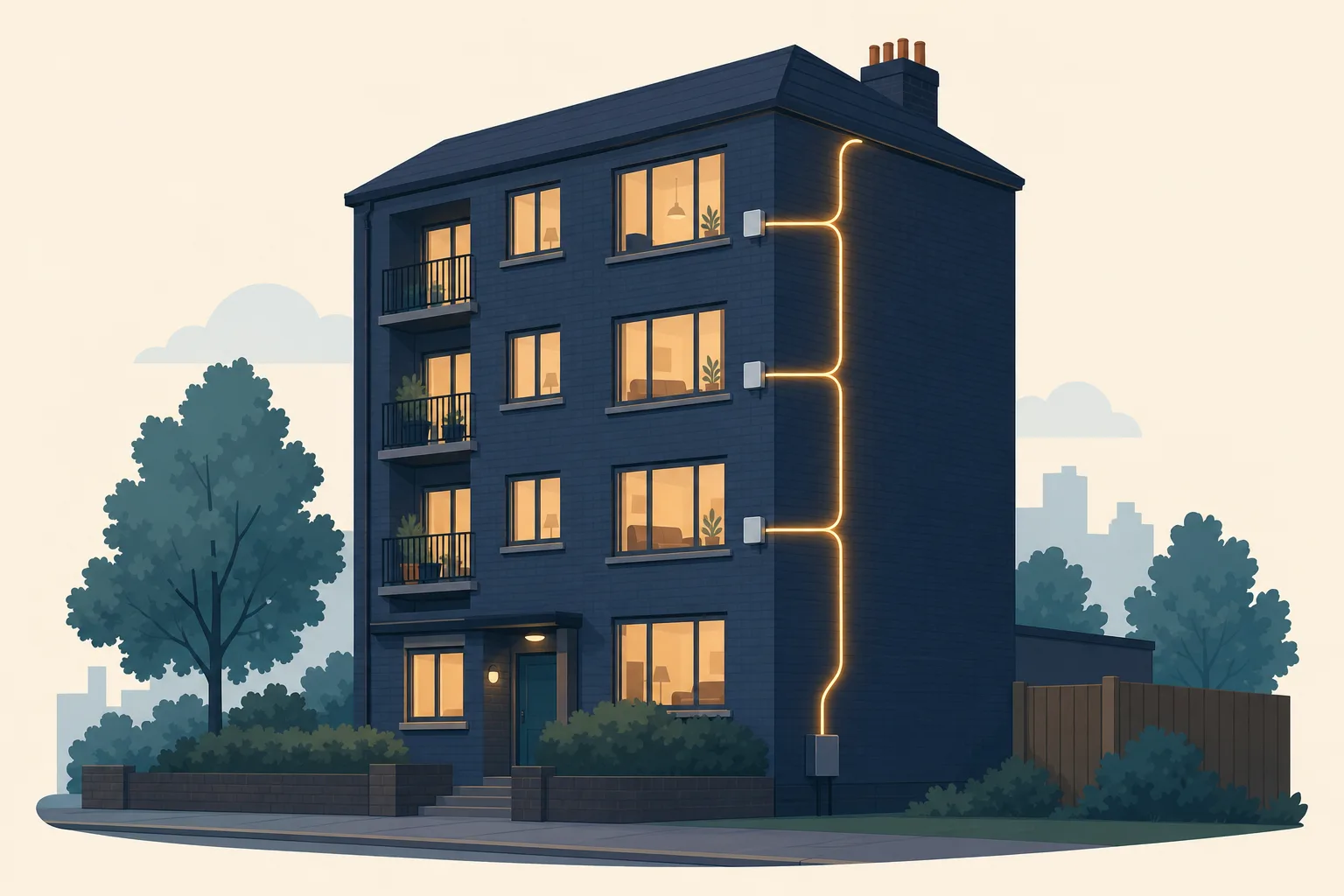
Ask why full fibre in flats takes so long and the answer is hardly ever the network. The cable can be sitting in the street outside, the provider ready to book the job, and it'll still wait months on a signature from somebody who doesn't live in the building. If you rent or own a flat, the person who decides whether you get fibre usually isn't you.
Why full fibre in flats waits on a signature
An operator that wants to bring fibre into a building it doesn't own needs the landowner's written permission first. The inside of your flat is yours. The route the cable has to take is not: the basement, the riser, the communal hallway and the wall it gets drilled through all belong to the freeholder. That permission is called a wayleave, and it's the most common reason a block sits unconnected while the houses on the same street get upgraded.
It's also why flats and altnets are an awkward fit. A network building down a residential road deals with pavements and front gardens. A network trying to reach forty flats has to find, contact and satisfy one organisation with no particular reason to hurry.
Who actually has to say yes?
The freeholder, or the managing agent acting on their behalf. Not you, not your neighbours, and not the provider.
A leaseholder owns the inside of a flat while the structure and the communal parts normally stay with the freeholder, so a building full of residents who all want fibre carries no weight on its own. In a purpose-built block that decision sits with one company. In a converted house split into three flats it might sit with a landlord who hasn't answered a letter in two years, which is where most of these stories actually stall.
What is a wayleave?
A wayleave is the landowner's written agreement letting an operator install equipment on or in their property and keep it there. It sets out where the kit goes, who maintains it, what happens if it ever needs removing, and who pays if something gets damaged.
The provider normally covers the work, so money is rarely the objection. The real sticking points are fire safety and building regulations, drilling through a structure the freeholder is liable for, and who carries the risk in ten years' time. Those are fair questions. The providers that get blocks done are the ones who turn up with drawings answering them instead of a form to sign.
What happens if the freeholder never replies?
Since the end of 2022 there has been a formal process for exactly that, and it ends at a tribunal rather than a stalemate. The Telecommunications Infrastructure (Leasehold Property) Act 2021 added a route to the Electronic Communications Code for buildings where somebody living in a flat has asked for a service and the landowner repeatedly fails to respond. The operator serves a set sequence of notices, and if the silence continues it can ask a tribunal to impose an agreement so the installation can go ahead anyway.
Two things are worth knowing about it. The access it grants is temporary, capped at 18 months, so it's a way to get a building connected rather than a permanent settlement. And the problem it was written for is not imagined: government and operator figures put the share of access requests to landlords that get no reply at all at around 40 per cent. The Act came into force on 26 December 2022 in England and Wales, and on 1 July 2023 in Scotland.
The gap the law leaves open
This is the part that disappoints people, so we'll say it plainly: the process deals with silence, not with refusal. A freeholder who reads the notice, replies and says no is outside it. So the situation residents describe most often, a managing agent who does answer the email and then declines, is the one the current law is least able to shift.
It's slow, too. Notices have to be served and left to expire before anything can be applied for, which is fair protection for a landowner and cold comfort if you've been waiting since last winter.
What is changing in 2026?
A stronger right for flat owners has been proposed, but it isn't law yet and nothing has changed on the ground. The government consulted on legislative proposals to give leaseholders in England and Wales a statutory right to request a gigabit-capable connection from their freeholder, with the freeholder unable to refuse unreasonably. That consultation closed on 16 February 2026 and the responses are still being worked through.
Ministers put the number of homes it could eventually unlock at up to 1.2 million. One detail matters if you rent rather than own: the new right as proposed was written for leaseholders, not tenants, so a renter would still be relying on their landlord to ask or to agree.
What you can do now
- Check the address rather than the postcode. Networks are built street by street and a block can be the exception on a road that is otherwise done, so start with what is actually available at your address.
- Find out who the landowner is. The freeholder and the managing agent are often not the same, and requests sent to the wrong one are a large share of the silence people run into.
- Put the request in from inside the flat. The formal route turns on a resident asking a provider for service, so registering interest with a network that builds to your area is what starts the clock rather than complaining to the agent.
- Ask whether the building is already served. Some blocks have a network in the basement from a previous agreement, in which case the job is a connection rather than a negotiation.
- Get your neighbours to ask too. It gives you no legal standing, but a managing agent weighing one request against nine tends to move faster.
- Consider a stopgap. Where a building is genuinely blocked, 5G home broadband needs no engineer and no permission, at the cost of two protections that do not come with it.
Our view
Flats are the part of the full fibre rollout policy hasn't solved, and the honest position is that a determined freeholder can still say no. What has changed is that silence no longer works as a way of avoiding the question. What may change next is whether a refusal has to be justified at all.
In the meantime the practical step is the same one as always: find out which networks reach your address, and if one of them does, the switch itself is the easy part.
Frequently asked questions
Can my landlord stop me getting full fibre?
In practice, yes. A freeholder who answers and refuses is within their rights, and no current law forces them to agree. The process added in 2021 only covers a landowner who does not reply at all.
Do I still need permission if the cable already reaches my building?
Usually yes. Fibre running past the front door, or even into a basement, is not the same as consent to run it through the risers and communal hallways to your door. That last stretch is the part the freeholder controls.
Who pays for the work in a block of flats?
The provider normally covers the installation, so cost is rarely the objection from the freeholder. The sticking points are more often fire safety, building regulations and who is liable for the equipment years later.
Can renters use the same process as leaseholders?
The existing route turns on a request from whoever is living in the flat, so a tenant in occupation can ask a provider to start it. The newer right the government consulted on was drafted for leaseholders rather than tenants.
How long does getting a block connected take?
There is no standard answer, because the wait is almost never the engineering. A cooperative managing agent can turn it round in weeks; an unresponsive one can push it past a year, and the formal notice route adds months on top.